“Authors do not choose a story to write, the story chooses us.” ― Richard P. Denney
Stories from Nature is my sandbox for exploring fundamental questions: about balancing work and play, the challenges of growing old in a not-so-healthy world, daily struggles and gratitude, our relation to one another and other living creatures, and so forth. (this preface was edited slightly 2.14.25,Valentine’s Day)
I believe that the best way to navigate this vast, uncharted wilderness is to tell stories, stories that arise from my experience as a teacher, and from the beliefs and perspectives I have gained from observing nature and natural processes. The purpose of the stories is not to provide answers, but to explore questions and ideas worth pondering.
While I have genuine concerns about where this world is headed, I don’t want to preach. I am saying, “This is how I did it, or how I see it,” but I’m not saying you should do it or view it the same way. YMMV.
In this brief preface, what I hope to explain is how stories arise from, or are built from, basic elements – the ingredients, if you will. It’s essential to be honest about what the elements are, and where they come from: which pieces are solid or appear relatively certain, and which parts are more hypothetical, based on inference or malleable.
What is a story? To my mind, this question boils down to three main elements: the circumstances, an audience, and a storyteller. The best storyteller must speak from experience, in the sense that “Experience is the best teacher.” Experience, whether a moment, a slice of time or a series of events, becomes a credible lens that allows us to understand the past or to look forward to what the future may hold.
In other words, the storyteller’s authority is grounded in experience.
Stories are precious lifeblood that can be passed from person to person, across generations, much like other forms of inheritance. Of course, to be effective, stories also rely on language (spoken or written), language chosen by the storyteller to connect with the audience and convey cultural meaning.
These relationships can be captured in a simple diagram (below):
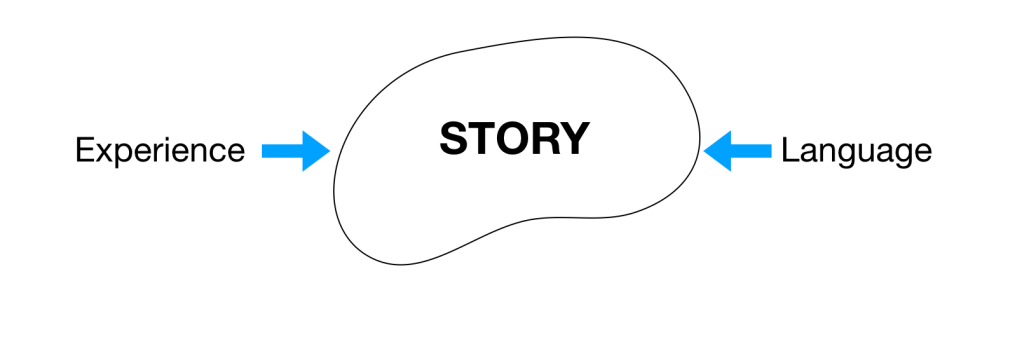
When I began teaching writing to first year college students, this diagram was a rubric for stories, as presented to me by seasoned professional writers. Essentially, the story sits at the crossroads of language and experience. But the language of the story is not the experience itself. Why?
Looking closer, this schematic says very little about the process or the timing of creating the story or telling it. All experience comes from the past, so the storyteller must remember what happened, in what order and maybe what caused it to happen. Memory is never perfect, not nearly so, but the storyteller relies absolutely on memory to derive meaning or significance from the events and observations.
And the audience? as they hear or read the story, and probably afterward, the audience must imagine what happened. Now we have brought (fallible) human minds into the mix, one to recall the experience and others to imagine it, with language as the bridge that connects them. As a result, our story rubric becomes more complex:
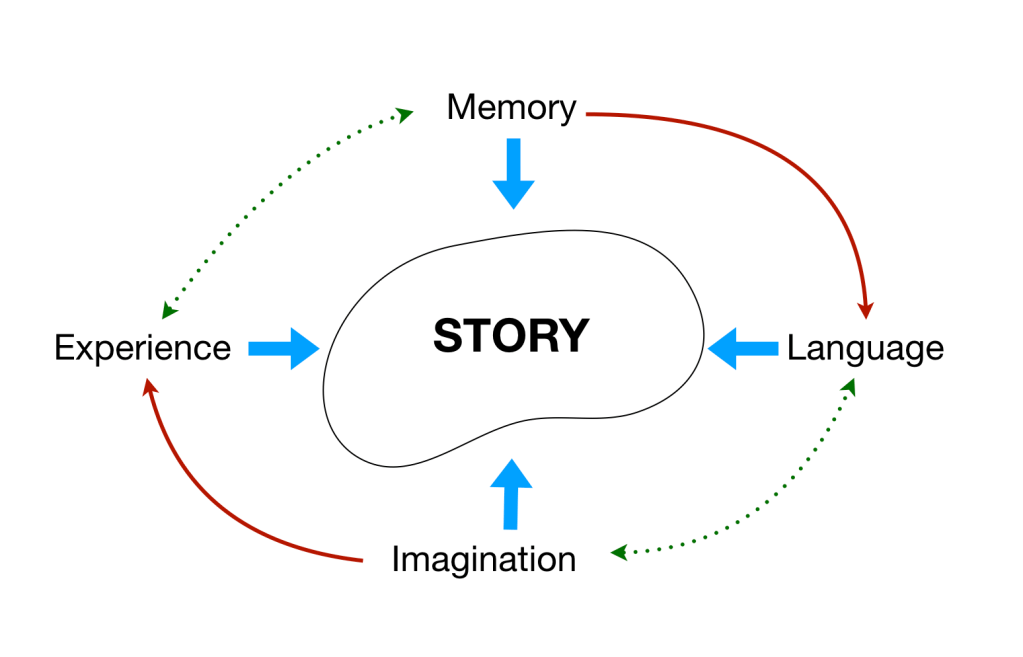
For instance, suppose I want to tell a story about birds that typically used to migrate south but now are overwintering in New England. I have to recall which species these are, make observations that capture important facts, choose appropriate language to engage the reader’s imagination, and connect the points I want to emphasize.
The better I can do these things, the more convincing and engaging the story, and the more effectively the story can guide the audience to see the world through a fresh lens.
I intend that the remainder of Stories from Nature will be mostly built on a general framework like the one outlined above. They will focus on nature itself: what it is, and what it is not. There will be some special terminology involved, but this should be kept to a minimum. Accordingly, I debated about the need for special text features, like footnotes, sidebars and a glossary, but for now I plan to keep things as close to simple narrative as possible. The biologist in me insists on giving others credit where credit is due, and this will probably be handled with footnotes.
My main goal in telling these stories is to share the pure joy of insight and discovery, and convey some of the marvels and mysteries of living creatures (including humans), important aspects that, unfortunately, go beyond the scope of what is usually taught in modern biology courses.


 anoutdooreducation